
It started the way most dangerous internet journeys begin. I thought to myself, “Maybe I should get a dash cam.”
That was it. One innocent thought. Ten minutes later I had thirty tabs open, three YouTube reviews playing at the same time, and one guy aggressively explaining dynamic range like he was defending a PhD thesis.
Apparently dash cams are not just cameras anymore. They are 4K cinematic surveillance devices with night vision, WiFi, GPS, parking mode, motion detection, loop recording, and possibly the ability to detect aliens.
All I wanted was proof in case someone brake checks me while eating a burrito and texting their cousin.
So I started comparing a few popular dash cams, and that is when the personalities of these things started to become very clear.
Btw, here is a RANDOM AI-generated picture of each dashcams, I know it looks pretty crap, but I am just too lazy to take pictures of all the dashcams.
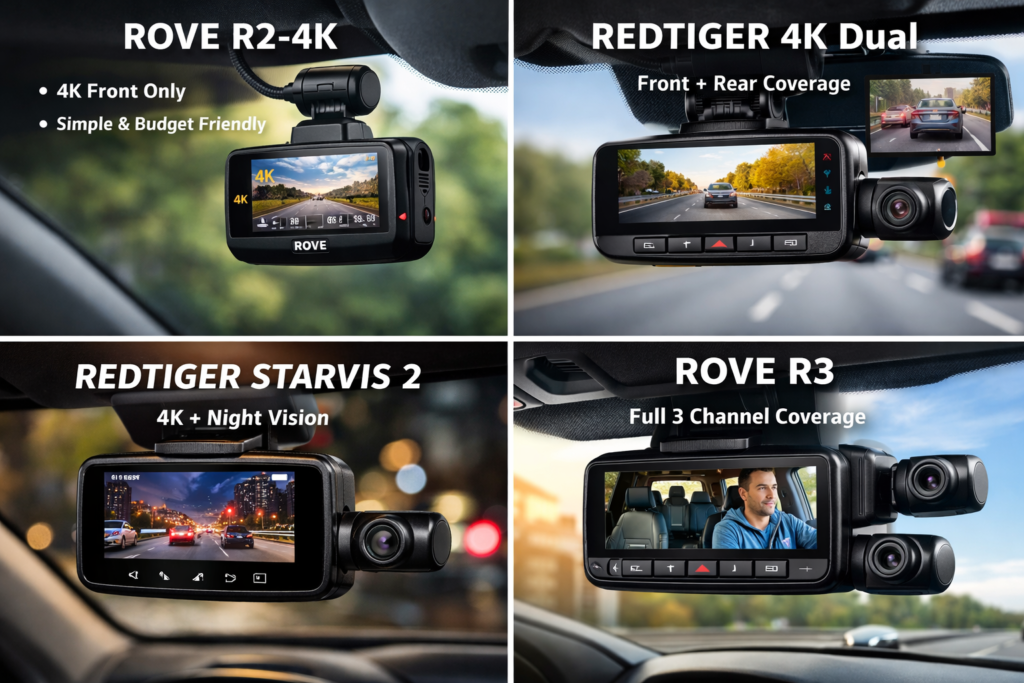
First I looked at the Rove R2-4K. This one felt like the dash cam equivalent of a dependable hatchback. Nothing flashy, nothing complicated, just a camera that records the road in front of you in proper 4K. It has WiFi, GPS, and the setup is so simple that even someone who still types with two fingers could probably install it before their coffee gets cold.
The only catch is that it records the front of your car and absolutely nothing else. If chaos happens behind you or inside the car, the R2 will politely pretend none of that exists.
Then I thought, “Okay maybe I should see what is happening behind me too.”
That is when I stumbled into the Redtiger 4K Dual. Suddenly there were two cameras.
One watching the road ahead and one keeping an eye on the tailgaters who drive three inches behind your bumper like they are trying to draft in Formula 1.
The front records in 4K, the rear records in 1080p, and it has WiFi, GPS, and loop recording.
The rear camera is not quite as sharp as the front, but honestly it is still clear enough to capture someone’s license plate and their questionable life choices.
But of course the internet never stops at “good enough.”
At some point during my research spiral I discovered the Redtiger Starvis 2, which sounded less like a dash cam and more like a spaceship sensor.
Apparently this one uses an upgraded sensor that handles low light better, which means night footage looks less like a blurry ghost movie and more like actual video.
Both the front and rear cameras record in 4K, and the whole thing runs through a large touchscreen that makes it feel more modern than the tiny button filled screens on cheaper cameras.
The downside is the price creeps up a bit, and it still does not watch the inside of the car. So if your passengers start arguing about pineapple on pizza, that debate will unfortunately remain undocumented.
Just when I thought I had reached peak dash cam complexity, I ran into the Viofo A119 V3.
This one is interesting because it almost feels like the anti dash cam.
No WiFi, no fancy touchscreen, no extra cameras.
It simply sits on the windshield in its little wedge shaped body and records 2.5K video with impressive reliability.
It has been around long enough that people trust it the way people trust that one friend who always shows up early to the airport.
It may not have the flashiest features, but when you need footage, it tends to actually be there.
At this point I believed I had seen every possible configuration of dash cams.
I was wrong.
Because then I found the Rove R3, which basically decided that if one camera is good and two cameras are better, then three cameras must be fantastic. This setup records the front, the rear, and the interior of the car.
It has a large touchscreen, WiFi, GPS, and enough coverage to make your vehicle feel like a tiny rolling security system. It is especially popular for rideshare drivers or anyone who wants full coverage of everything happening in and around the car.
The tradeoff is that installing it takes a little more effort, and if you want proper parking mode you will probably end up wiring it into the car.
By the time I finished this comparison I had learned three things.
First, dash cams range from simple “record the road and move on with your life” devices to full blown multi camera surveillance systems.
Second, most people only really need two cameras. One facing forward and one facing backward.
And third, researching dash cams on the internet is a dangerous activity because every review convinces you that you absolutely must upgrade to the next model.
So if someone forced me to simplify the whole situation, here is how the story ends.
If you just want basic front protection, the Rove R2-4K or the Viofo A119 V3 will quietly do the job without drama.
If you want front and rear coverage without spending too much money, the Redtiger 4K Dual is a very reasonable middle ground.
If you want better night recording and a nicer interface, the Redtiger Starvis 2 starts to make a lot of sense.
And if you want cameras watching everything from every angle like a tiny rolling reality show, the Rove R3 is the full coverage option.
In the end the most important rule of dash cams is surprisingly simple.
The best dash cam is the one that is actually recording when something ridiculous happens on the road.
Because if there is one thing every driver eventually learns, it is this:
The moment you do not have a camera running is exactly when someone decides to perform the most creative driving maneuver you have ever seen.